Doppelherz and Protefix producer – Queisser Pharma opens an office in Poland
Queisser Pharma Poland, a producer of Doppelherz and Protefix brands, opened an office in Warsaw in the Nefryt office building in Warsaw's Mokotów district.
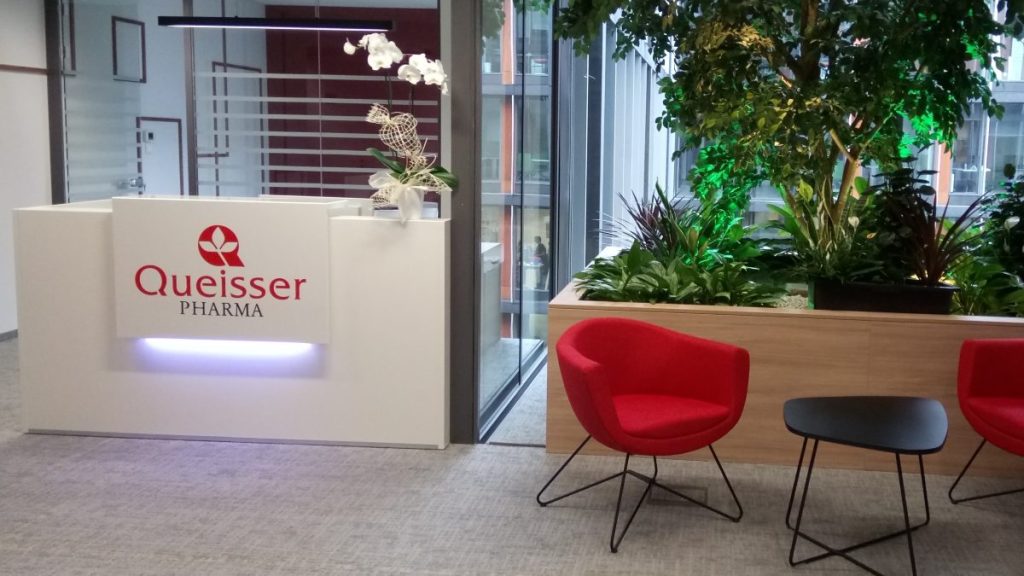
Queisser Pharma Poland joins the group of companies that have their offices in Nefryt building located in Warsaw’s Słuzewiec. The Polish branch of the international pharmaceutical group signed the lease for a period of 5 years, renting almost 300 sq m. AXI IMMO’ consultants have represented the Client in negotiations, as well as in the whole process of selection, design and arrangement of modern office space.
Queisser Pharma GmbH &CO.KG is an international manufacturer and distributor of pharmaceutical, medical devices and food supplements with more than a hundred years of tradition. The company headquartered in Flensenburg (Germany) is a part of the Dethleffsen Holding and consistently implements its development policy in other countries. An important element of that strategy was also creating Queisser Pharma Poland and opening the Warsaw office.
The new strategy of Queisser Pharma
The opening of a new branch in Poland was an important component of the new company strategy. The Polish market has a great potential, so we decided to start looking for an office space in Warsaw. For our marketing team, responsible for the promotion of brands Doppelherz and Protefix, we needed space in an intimate building. Comfortable communication solutions, close proximity to the to airport, accessibility of parking places and other neighborhood amenities like shops or restaurants were a priority for us – comments Renata Kasprzyk, General Manager at Queisser Pharma Poland.
Queisser Pharma decided to conduct the process of looking, arrangement and organization of new office in Poland in a two months. It was possible to achieve thanks to close cooperation with professional AXI IMMO’s Office team, that is specialized in providing complex services for tenants – from market analysis through negotiations and the working environment, analysis to project management during design and construction works.
High requirements realized instantly
We carried out Client’s needs analysis and chose the right building. Then, after negotiations of legal and financial conditions, we were ready to move to a new phase of the process. During several technical meetings, we set out details regarding fit-out. Office equipment consultancy and coordination and completion of fit-out works ended our efforts. – comments Emil Chwieduk, Office Negotiator at AXI IMMO.
Bartosz Oleksak, also Office Negotiator at AXI IMMO, who supported the fit-out process adds: We are very pleased that Queisser Pharma Poland trusted us in organizing the whole process and we have a great satisfaction from providing its employees comfortable working environment in just two months. It was a big challenge for us, but the results and client satisfaction of our work make us proud.
Nefryt in Warsaw’s Mokotów
Nefryt Atrium is a seven-storey office building offering 15,000 sq m of A class office space and almost 1,500 sq m commercial and service space. Location in Warsaw’s Mokotow, by the junction of Domaniewska and Rodzin Hiszpanskich Streets and in the vicinity of Galeria Mokotow, is one of the biggest advantages of this office building.
Nefryt is very popular among tenants. Its architectural design was developed by a reputable firm JEMS Architekci.
Recent articles

22 July 2026
Sale & Leaseback: Leveraging Real Estate as a Strategic Financing Tool for Business Growth
AXI IMMO explains why more companies are using commercial real restate to unlock capital for investment, expansion and business transformation
17 July 2026
Modern Offices That Support Talent Acquisition and Employee Performance
An AXI IMMO Expert highlights the key trends shaping the search for new office space
14 July 2026
AXI IMMO Supports UDH’s Expansion into a New Region of Poland
Food and Beverage Distributor Leases 1,400 sq m at Park Rysy Kraków

16 June 2026
AXI IMMO advises Logfret Poland – the logistics company moves to SEGRO Logistics Park Warsaw, Nadarzyn
4,900 sq m for an international logistics operator, with AXI IMMO advisory.