Sale & Leaseback: Leveraging Real Estate as a Strategic Financing Tool for Business Growth
AXI IMMO explains why more companies are using commercial real restate to unlock capital for investment, expansion and business transformation
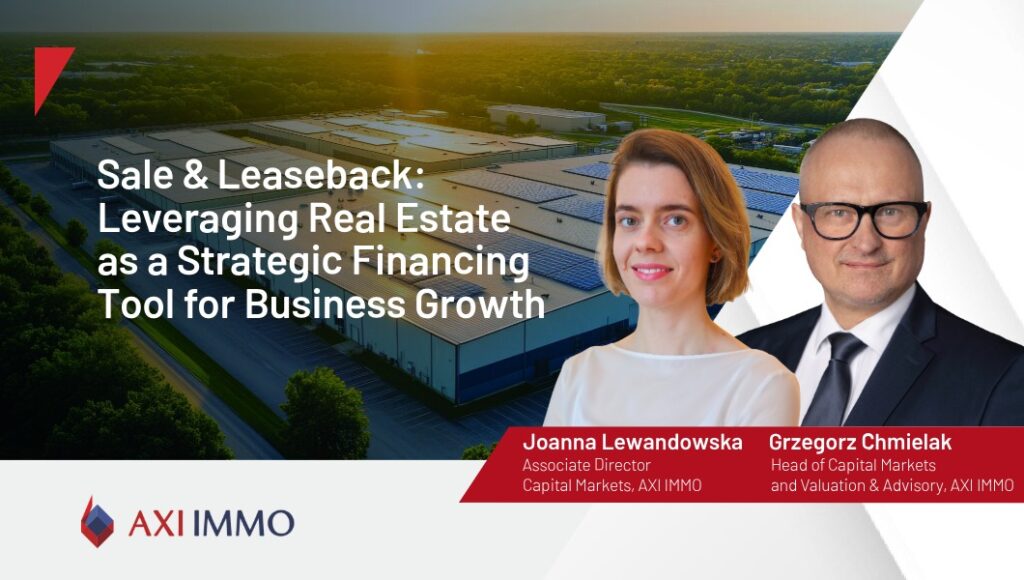
Commercial real estate can serve a far more significant purpose than simply providing operational premises. For many manufacturing, logistics and industrial businesses, it has become an integral component of capital structure and a strategic source of growth financing. Increasingly, capital tied up in fixed assets is being redeployed to support technological investment, energy transition initiatives, operational expansion and organisational transformation. This is the premise behind the sale and leaseback (SLB) model, whereby a company sells a property while simultaneously entering into a long-term lease agreement for the same asset. As Joanna Lewandowska, Associate Director, Capital Markets, AXI IMMO, explains, this solution enables occupiers to unlock capital embedded in their real estate while maintaining uninterrupted business operations, while offering investors access to income-generating assets underpinned by long-term cash flows.
Estimated reading time: 9 minutes
A New Role for Real Estate in Corporate Strategy
For corporate occupiers, a sale and leaseback transaction represents a fundamental shift in how real estate assets are viewed. Rather than retaining ownership, companies move from being property owners to occupiers, with no disruption to their day-to-day operations. In practical terms, an illiquid fixed asset is transformed into deployable capital that can be reinvested into the core business. This approach reduces the capital and organisational resources dedicated to property ownership, maintenance and future development. At the same time, it enables companies to redirect funds released from their real estate holdings towards strategic objectives and business expansion.

“The sale and leaseback model should not be regarded simply as a property disposal. It is a capital optimisation tool that can enhance liquidity, support investment in growth and innovation, and streamline a company’s financing structure. Our experience confirms what broader market analysis increasingly highlights: operational real estate may be essential to a company’s activities, but ownership of that real estate does not necessarily constitute a competitive advantage.”
Joanna Lewandowska, Associate Director,
Capital Markets,
AXI IMMO
Releasing Capital Without Disrupting Operations
One of the principal advantages of a sale and leaseback transaction is the ability to release capital embedded in real estate assets without affecting daily business activities. The company continues to occupy the same facility under a long-term lease agreement, while the proceeds of the sale can be deployed to support:
- Growth and expansion projects;
- Business modernisation initiatives;
- Technology investments;
- Automation programmes;
- Organisational efficiency improvements
The model is particularly popular among manufacturers, logistics operators and warehouse occupiers, where real estate serves primarily as operational infrastructure rather than a source of market differentiation.
For many businesses, sale and leaseback is now more than a means of raising capital. It is increasingly viewed as part of a broader strategic discussion around capital allocation, balance-sheet optimisation and the financing of future growth. Such transactions often accompany business reorganisations, ownership changes, IPO preparations, acquisitions, production expansion programmes and ESG-related initiatives.
In this context, real estate becomes an enabler of strategic change rather than merely a passive asset. The transaction evolves from a one-off disposal into a sophisticated capital management tool that supports long-term value creation.
“Any decision to pursue a sale and leaseback transaction should be preceded by a comprehensive assessment of its impact on cash flow, the balance sheet, future rental obligations and operational flexibility. The greatest value is achieved through a carefully structured transaction, where the sale price, lease term, indexation mechanism and allocation of responsibilities between the parties are aligned with the company’s long-term objectives.”
Joanna Lewandowska, Associate Director,
Capital Markets,
AXI IMMO
From Asset Preparation to Transaction Completion
A successful sale and leaseback process begins with a detailed review of the asset. This should include an assessment of the property’s operational importance, technical condition, legal and planning status, investor appeal and alternative-use potential. A thorough analysis of both asset value and market rent is equally critical, as the sale price and lease terms are intrinsically linked in this transaction structure.
At the preparation stage, companies should model multiple scenarios relating to:
- Lease duration;
- Rental levels;
- Indexation provisions;
- Operating cost allocations;
- Capital expenditure (CAPEX) responsibilities;
- Renewal options;
- Security arrangements;
- Required operational flexibility.
Only after these factors have been properly evaluated can a controlled marketing process commence, reducing the likelihood of value erosion during due diligence and increasing the probability of a smooth closing process.
Sale and Leaseback Versus Bank Financing: Complementary Rather Than Competing Solutions
Sale and leaseback should not necessarily be viewed as an alternative to bank financing. In practice, it is increasingly used alongside traditional debt facilities to support different corporate funding objectives.
Bank lending secured against property is generally constrained by loan-to-value (LTV) ratios, credit policies and the borrower’s creditworthiness. By contrast, a sale and leaseback transaction enables a business to release capital without increasing financial indebtedness, while preserving access to debt financing for working capital requirements or future investment projects. As a result, businesses can achieve greater financial flexibility and enhanced capacity to execute their growth strategies.
From an investor’s perspective, one of the most attractive features of sale and leaseback transactions is predictability. The investor acquires a fully operational, income-producing asset rather than a property requiring lease-up, repositioning or substantial capital investment.
Investment analysis therefore focuses not only on the quality of the building itself, but also on:
- Tenant covenant strength;
- Lease duration;
- Rental levels;
- Strategic importance of the asset to the occupier;
- Alternative-use potential.
- This creates a stable and transparent income profile from day one of ownership.
Where Does the Risk Lie? In the Quality of the Lease Structure
Within the sale and leaseback model, investment risk is generally considered relatively low, particularly where a financially robust occupier commits to a lease term of 10, 15 or even 20 years. A significant element of value creation lies in the relationship between investor and occupier. Investors gain a tenant with extensive operational knowledge of the property and often a strong sense of stewardship, having previously owned and occupied the asset for many years. Both asset valuation and the long-term security of the transaction depend on a carefully drafted lease agreement. Critical factors include:
- Sustainable rent levels;
- Clear rental indexation mechanisms;
- Precisely defined landlord and tenant responsibilities;
- Flexibility for future expansion and adaptation of the property.

“An overly aggressive rent level may enhance the sale price on the transaction date, but can undermine the effectiveness of the structure over the lease term. For boards and CFOs, the key consideration is not simply how much capital can be released, but also how future rental obligations will affect margins, liquidity and the company’s ability to continue investing. Companies should also review the completeness of legal and technical documentation, capital expenditure history, financial modelling assumptions and tax considerations, including transaction classification and its impact on future tax liabilities.”
Grzegorz Chmielak,
Head of Capital Markets,
AXI IMMO
Sale and Leaseback Transactions in Poland: Recent Market Activity
The sale and leaseback segment remains active within Poland’s industrial and logistics real estate market. Over the past three years, such transactions have encompassed almost 700,000 sq m of space. The most notable example was the acquisition of two Eko-Okna manufacturing facilities by a US investor in a transaction exceeding PLN 1 billion. The first quarter of 2026 also saw further activity, including the acquisition of a logistics portfolio occupied by Raben Group by W. P. Carey, as well as the purchase of Goodyear’s logistics facility in Tarnów by Appeninn Plc.
These transactions demonstrate that sale and leaseback is increasingly being recognised both as a capital optimisation strategy for occupiers and as an attractive source of long-term, income-generating assets for investors. AXI IMMO has also advised on several transactions for undisclosed clients and continues to observe growing interest in the model as part of wider corporate financing strategies.
The firm supports clients throughout the entire process, from assessing asset suitability and transaction structuring to investor engagement, transaction execution and commercial negotiations.
About AXI IMMO
AXI IMMO offers comprehensive advisory services related to commercial real estate, including warehouse and office leasing and property management, real estate valuation, land acquisition, and sales. The firm also offers B2B and B2C supply chain management services. AXI IMMO’s greatest advantage is combining international business standards with deep local market knowledge.
AXI IMMO has received numerous awards, including Best Local Agency of the Year in 2012–2019 and 2021 in the CiJ Awards and Best Team in the Warehouse Sector in 2016–2017. In 2019 and 2023, the firm was the winner in the Local Agency category, and in 2024, it was named Advisor of the Year at the CEE Investment Awards. AXI IMMO was named Local Agent of the Year in 2023 and 2024 in the CEE region at the CEEQA awards. The firm’s most recent achievement is the title of Advisor of the Year in the Prime Property Prize 2024.
Recent articles
20 October 2026
Office Market Polarisation Accelerates: Tenants Compete for Prime Locations While Older Buildings Struggle to Remain Competitive
An AXI IMMO expert explains why occupiers are increasingly choosing modern office space in prime locations and how this is reshaping the Polish office market.
16 October 2026
EXPO REAL 2026: Investors Return to the Market, but Asset Quality and Effective Management Are Becoming Increasingly Important
AXI IMMO experts share their key takeaways from EXPO REAL 2026, highlighting returning investor activity, greater capital selectivity and the growing importance of active asset management.
13 October 2026
Cross-Docking: Meeting the Growing Demand for Faster Deliveries
The AXI IMMO expert explains how cross-dock facilities work, which occupiers benefit most from them and why their role is growing as demand for faster deliveries increases.

13 October 2026
How to Find Warehouse Space in Poland? 7 Questions Every Business Should Ask Before Leasing
Running out of storage space? Learn how to find the right warehouse in Poland, prepare a warehouse brief, choose the best location and compare warehouse leasing with a Build-to-Suit (BTS) solution. Whether you’re expanding an e-commerce operation, entering the Polish market, relocating a distribution centre or simply running out of room for inventory, finding the […]