Modern Offices That Support Talent Acquisition and Employee Performance
An AXI IMMO Expert highlights the key trends shaping the search for new office space
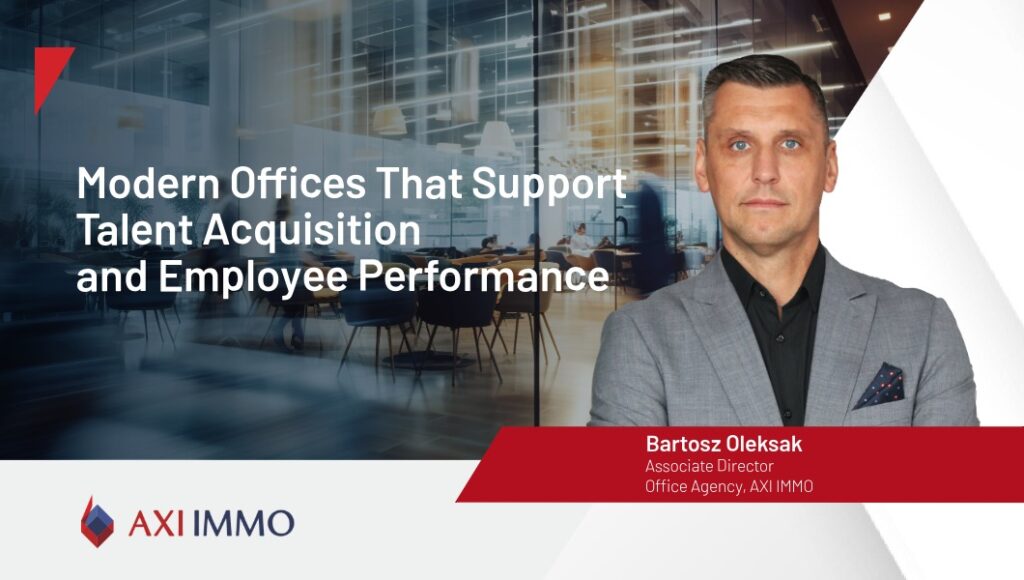
The office is increasingly becoming a source of competitive advantage for employers. More importantly, it is no longer simply a company address. According to Bartosz Oleksak, Office Agency Expert at AXI IMMO, factors such as location, building quality and workplace design now have a direct impact on employee comfort, team performance and a company’s attractiveness to both current and prospective talent.
Estimated reading time: 8 minutes
A well-designed workspace is not merely a matter of aesthetics or corporate image; it is a strategic tool that supports the day-to-day functioning of an organisation. From improving concentration and collaboration to boosting productivity and reducing staff turnover, office design plays a crucial role in business performance. Increasing attention is also being paid to air quality, access to natural daylight, interior layout, acoustics and the presence of natural elements, all of which contribute to the health and wellbeing of office users. At a time when businesses are embracing AI more widely than ever, people remain the foundation of every organisation. A workplace that genuinely makes employees’ daily lives easier should no longer be viewed as a cost, but rather as an investment in business stability, resilience and long-term growth.
From this article, you will learn:From this article, you will learn:
- Why does office quality have a direct impact on employee productivity and well-being?
- How to create a workplace that supports business growth and strengthens your company’s competitive advantage?
- What to consider when selecting a modern office?
- How can office space support recruitment and help build engaged, high-performing teams?
Office Location Influences Recruitment and Access to Talent
Office location is increasingly influencing both recruitment outcomes and employees’ willingness to work from the office. Well-connected buildings located near major transport hubs, including underground stations and tram lines, significantly expand access to talent pools and encourage office attendance. A shorter and more predictable commute reduces stress, one of the main factors affecting workplace comfort, particularly in large cities.
For employers, this translates into a greater likelihood of regular office attendance, improved team collaboration and a more attractive working environment. Conversely, peripheral locations with poor public transport links may limit access to skilled professionals and make it more difficult to build strong, stable teams. This is why choosing an office location is no longer simply an administrative decision; it has become a key component of both HR and overall business strategy.
The immediate surroundings of an office are equally important. Access to amenities such as restaurants, cafés, retail outlets, fitness centres and social spaces contributes significantly to employees’ day-to-day convenience and influences how they perceive the attractiveness of a location. In practice, well-developed urban and service infrastructure enables employees to organise their working day more effectively while reducing the need for additional travel.

“Social and urban development trends have reshaped the decisions of office property owners, who have moved away from creating traditional office-only districts in favour of mixed-use developments that combine multiple functions within a single complex. These vibrant urban environments encourage people to make better use of their time before and after work. As a result, they enhance the overall workplace experience. For employers, this means a more competitive working environment, particularly at a time when hybrid working has become the dominant model. In this context, the office – and by extension the employer – must provide employees with compelling reasons to come into the workplace. Locations that offer access to dining, retail and leisure facilities can increase employee engagement and help reduce staff turnover.”
Bartosz Oleksak, Associate Director Office Agency, AXI IMMO
Modern Offices Enhance Productivity and Workplace Experience
The quality of the building itself and the comfort it provides are equally important. Modern office buildings offer improved air quality, advanced ventilation and air-conditioning systems, greater energy efficiency and a range of solutions designed to support employee health and wellbeing, all of which can directly improve team performance.
This is particularly relevant for knowledge-based work, where indoor air quality and microclimatic conditions have a measurable effect on concentration and work pace. Research into green buildings suggests that improvements in workplace quality may be associated with lower absenteeism, enhanced wellbeing and higher employee satisfaction with working conditions.
Combined with thoughtful interior design, these features create an environment that genuinely improves organisational performance. Optimising workspace – from ergonomic workstations and quiet zones to relaxation areas and effective acoustic solutions – can reduce stress, enhance concentration and contribute to higher productivity.
“Natural light and greenery improve how people perceive a workspace and can increase job satisfaction. Ergonomic furniture helps reduce fatigue and health-related issues, while natural light, plants and dedicated wellbeing areas boost morale and employee satisfaction. A carefully balanced combination of open-plan areas and smaller meeting rooms improves communication and supports both collaboration and focused individual work.”
Bartosz Oleksak, Associate Director Office Agency, AXI IMMO
Ergonomic Workplaces Support Employee Health and Performance
The role of greenery and natural elements in the workplace also deserves particular attention. Natural light and planting can positively influence the workplace experience and help teams work more effectively. A notable example is Roger S. Ulrich’s study published in Science, which demonstrated that views of nature can facilitate recovery and positively affect users’ wellbeing.
Although the research focused on post-operative patients, its findings can be applied to workplace design, where comfort, stress levels and wellbeing influence employees’ day-to-day functioning. In practice, this means that features such as greenery, open views, natural materials and well-designed relaxation spaces should be regarded not merely as aesthetic additions, but as meaningful contributors to better working conditions.
Certified Office Buildings and ESG Are Becoming Increasingly Important to Employees
Current workplace trends also highlight the growing importance of sustainability. Office buildings certified under schemes such as LEED and BREEAM are widely perceived as more responsible and forward-thinking, while also providing healthier working environments. For many jobseekers, such credentials signal that a company is committed to sustainable development, enhancing its appeal according to prospective employees.
“Office optimisation does not necessarily mean reducing floor space. Increasingly, it is about aligning workspace with the actual working model and reallocating budgets from underutilised square metres to solutions that improve workplace quality and team productivity. A smaller but better-designed office can provide a higher-quality fit-out, improved acoustics, ergonomic workstations, collaboration zones, focused work areas and dedicated wellbeing spaces. In a hybrid working model, this approach makes particular sense because the office must offer value that remote work cannot provide: opportunities for collaboration, meetings, relationship-building and knowledge sharing within a carefully designed environment.”
Bartosz Oleksak, Associate Director Office Agency, AXI IMMO
The Office Is Becoming a Strategic Business Asset
In conclusion, a modern and functional office is far more than a matter of appearance. It is a tangible investment in people. An attractive location and thoughtfully designed workspace can help reduce staff turnover and support recruitment efforts. Conversely, an office situated on the outskirts of a city with poor transport connections may limit access to skilled talent and hinder organisational growth.
As a result, the office is increasingly moving beyond its role as an operational cost and becoming a strategic contributor to long-term business stability. For management boards, HR teams, workplace managers and finance departments alike, this means viewing office space through a much broader lens than rental costs alone.
Autor
Bartosz Oleksak, Associate Director Office Agency, AXI IMMO
About AXI IMMO
AXI IMMO offers comprehensive advisory services related to commercial real estate, including warehouse and office leasing and property management, real estate valuation, land acquisition, and sales. The firm also offers B2B and B2C supply chain management services. AXI IMMO’s greatest advantage is combining international business standards with deep local market knowledge.
AXI IMMO has received numerous awards, including Best Local Agency of the Year in 2012–2019 and 2021 in the CiJ Awards and Best Team in the Warehouse Sector in 2016–2017. In 2019 and 2023, the firm was the winner in the Local Agency category, and in 2024, it was named Advisor of the Year at the CEE Investment Awards. AXI IMMO was named Local Agent of the Year in 2023 and 2024 in the CEE region at the CEEQA awards. The firm’s most recent achievement is the title of Advisor of the Year in the Prime Property Prize 2024. Most recently, in 2025, AXI IMMO was awarded the title of Warehouse Agency Team of the Year by the Eurobuild Awards jury.
Recent articles
20 October 2026
Office Market Polarisation Accelerates: Tenants Compete for Prime Locations While Older Buildings Struggle to Remain Competitive
An AXI IMMO expert explains why occupiers are increasingly choosing modern office space in prime locations and how this is reshaping the Polish office market.
16 October 2026
EXPO REAL 2026: Investors Return to the Market, but Asset Quality and Effective Management Are Becoming Increasingly Important
AXI IMMO experts share their key takeaways from EXPO REAL 2026, highlighting returning investor activity, greater capital selectivity and the growing importance of active asset management.
13 October 2026
Cross-Docking: Meeting the Growing Demand for Faster Deliveries
The AXI IMMO expert explains how cross-dock facilities work, which occupiers benefit most from them and why their role is growing as demand for faster deliveries increases.

13 October 2026
How to Find Warehouse Space in Poland? 7 Questions Every Business Should Ask Before Leasing
Running out of storage space? Learn how to find the right warehouse in Poland, prepare a warehouse brief, choose the best location and compare warehouse leasing with a Build-to-Suit (BTS) solution. Whether you’re expanding an e-commerce operation, entering the Polish market, relocating a distribution centre or simply running out of room for inventory, finding the […]