The Warsaw Office Market Is Shifting.The Best Office Space Is Becoming Scarce
AXI IMMO analyses how falling vacancy rates and limited new office supply are reshaping the Warsaw office market and occupiers’ leasing strategies
- Why the availability of modern office space in central Warsaw is shrinking and how this is reshaping the leasing market?
- How falling vacancy rates and limited new supply are changing the balance between occupiers and landlords?
- Why companies planning a relocation need to start their office search significantly earlier than before?
- How the Warsaw office market may evolve through 2028 and why quality and availability will become increasingly important?
Estimated reading time: 10 minutes
In Warsaw’s office market, price is no longer the only key factor in negotiations – an increasingly significant challenge is finding the right office space in the first place. Vacancy in the city centre has fallen to 4.8%, while in the Rondo Daszyńskiego area it stands at just 3.6%. With demand remaining high and development activity limited, the best-quality space is being absorbed quickly, strengthening landlords’ negotiating position and requiring companies to plan relocations further in advance, says Sara Romanowska, Senior Advisor, Office Agency, AXI IMMO.
Warsaw Faces a Supply Gap
Warsaw’s office market has been experiencing a pronounced supply gap since 2023. By the end of the year, only around 28,000 sq m of modern office space is expected to be delivered, making total new supply in 2026 one of the lowest levels ever recorded in the capital. A significant increase in development activity is not expected in the following years either. Rising construction costs, more expensive financing and greater investor caution continue to limit the number of new projects.
At the same time, demand for office space remains high. In the first half of 2026, occupier activity reached 420,000 sq m, representing a 38% increase year-on-year. Large lease transactions have returned to the market, while companies are increasingly treating the office as a tool that supports business growth, team collaboration and organisational culture.
Sara Romanowska, Senior Advisor, Office Agency, AXI IMMO, comments: “Warsaw’s office market is entering a very different phase from the one we observed immediately after the pandemic. Today, the challenge is not a lack of demand, but the declining availability of modern office space in the best locations. In the city centre in particular, the choice of large, high-quality units is shrinking rapidly. This is gradually shifting the balance of power in negotiations and means that occupiers planning a relocation should start the process much earlier than they did just a few years ago.”
Vacancy Is Falling as Choice in the City Centre Narrows
Under these conditions, a further decline in vacancy is a natural consequence. At the end of the first half of 2026, Warsaw’s average vacancy rate stood at 8.5%, down 2.3 percentage points year-on-year. The trend is particularly pronounced in central locations, where the vacancy rate fell to just 4.8%. This means that in many of the most sought-after locations, occupiers now have very limited choice of available space.
The scale of the trend is even more evident in Warsaw’s most attractive business locations. In the Rondo Daszyńskiego area, which has become the capital’s principal business hub, the vacancy rate currently stands at just 3.6%. This is a level typical of markets with severely constrained availability, where occupiers need to plan their space requirements well in advance.
The Office Market Is Increasingly Rewarding Quality
Importantly, the decline in vacancy is not driven solely by occupier activity. The withdrawal of older, less competitive buildings from the market is also becoming increasingly significant. Owners of properties that no longer meet current technical or environmental standards are increasingly choosing to modernise them or convert them to alternative uses, most commonly residential. As a result, the stock of available office space is contracting further.
Sara Romanowska, AXI IMMO, notes: “Falling vacancy does not mean that every building automatically becomes more attractive. The market is becoming increasingly polarised. Occupiers are focusing on modern, well-located and energy-efficient projects, while older properties need to compete through refurbishment, upgrades in standard or more flexible commercial terms. In some cases, owners are also opting to convert properties to alternative uses, further reducing the office stock.”
Lower Office Availability Strengthens Landlords’ Position
Declining availability is strengthening landlords’ position and is increasingly reflected in rental levels. In Warsaw’s central zones, headline rents currently range from EUR 15 to EUR 28/sq m/month, while in the most prestigious prime schemes they have reached EUR 25–32/sq m/month. At the same time, incentive packages offered to occupiers are gradually being reduced, despite having been a standard element of lease negotiations only a few years ago.
Changing market conditions also require a new approach from occupiers. Companies increasingly need to begin their office search much earlier than before. This is particularly relevant for organisations planning to relocate to the city centre or seeking larger office units. Delaying a decision may result in a lack of available options that meet the company’s requirements.
2027 Could Bring Record-Low New Office Supply
What changes can be expected over the coming quarters? The most likely scenario is a further decline in vacancy. All indications are that limited new development supply will continue to meet relatively high demand for modern office space. At the end of the first half of 2026, only around 130,000 sq m of office space remained under construction, with more than 90% of projects located in the city’s central zones. New office supply in 2027 is expected to reach its lowest level in many years, with a more visible recovery in development activity anticipated only in 2028.
As a consequence, the availability of office space is expected to contract further, particularly in modern Class A buildings. In the most attractive locations, vacancy may fall to levels that significantly restrict choice for occupiers seeking larger offices. Increasingly, the key challenge will therefore be not negotiating financial terms, but finding suitable space in the preferred location.
A further decline in vacancy will also support rental growth, particularly in projects offering the highest technical standards, environmental certification and attractive locations. At the same time, the importance of modernising older buildings will continue to increase as the gap between modern and outdated assets becomes increasingly visible.
The Trend Is Also Visible Beyond Warsaw
It is worth noting that falling vacancy in the centres of major office markets is not unique to Warsaw. The trend is becoming increasingly visible in central locations in regional cities, including Kraków. Across Poland, developers are limiting the launch of new office projects due to high construction costs, more expensive financing and a more cautious approach among investors. As a result, the supply of modern office space in regional markets is also growing much more slowly than it did a few years ago.
At the same time, demand remains stable, supported by the business services sector, IT companies, centres of excellence and organisations maintaining hybrid working models. Occupiers are increasingly focused on space quality, building energy efficiency, environmental certification and transport accessibility. This is resulting in faster absorption of the best projects and a gradual reduction in the availability of the most attractive office space outside the capital as well.
Warsaw, however, remains the most advanced example of this trend. The availability of modern office space in the city centre is contracting faster than in regional markets. This is why the capital is the first to experience the consequences of the shortage of new development in the form of a marked decline in vacancy, rising rents and a stronger negotiating position for landlords. With development activity remaining low, similar trends can be expected to become increasingly visible in Poland’s other major cities.
Occupiers Need to Plan Relocations Further in Advance
Warsaw’s office market is currently experiencing a clear compression in vacancy. Record-low new supply, sustained high occupier activity and the gradual withdrawal of some older buildings from the market are causing availability to decline steadily. This trend is expected to continue over the coming quarters, further strengthening landlords’ position, supporting rental growth and increasing competition for the best office space. There are growing indications that by 2028, the availability of high-quality space, rather than rental levels alone, will become one of the key factors influencing occupier decisions in Warsaw and Poland’s other major office markets.
Sara Romanowska, AXI IMMO, concludes: “Over the next two years, one of the most important criteria in occupier decision-making may no longer be the rental level itself, but the availability of suitable space. Companies seeking large, modern offices in the best locations will need to plan their requirements further in advance. With a limited pipeline of new projects, a well-prepared leasing strategy and an appropriately early start to the process will become increasingly important.”
Autor

Sara Romanowska, Senior Advisor
Office Agency, AXI IMMO
About AXI IMMO
AXI IMMO offers comprehensive advisory services related to commercial real estate, including warehouse and office leasing and property management, real estate valuation, land acquisition, and sales. The firm also offers B2B and B2C supply chain management services. AXI IMMO’s greatest advantage is combining international business standards with deep local market knowledge.
AXI IMMO has received numerous awards, including Best Local Agency of the Year in 2012–2019 and 2021 in the CiJ Awards and Best Team in the Warehouse Sector in 2016–2017. In 2019 and 2023, the firm was the winner in the Local Agency category, and in 2024, it was named Advisor of the Year at the CEE Investment Awards. AXI IMMO was named Local Agent of the Year in 2023 and 2024 in the CEE region at the CEEQA awards. The firm’s most recent achievement is the title of Advisor of the Year in the Prime Property Prize 2024.
Recent articles
23 September 2026
The Warsaw Office Market Is Shifting.The Best Office Space Is Becoming Scarce
AXI IMMO analyses how falling vacancy rates and limited new office supply are reshaping the Warsaw office market and occupiers’ leasing strategies

17 September 2026
The best Real Estate Agencies in Poland
Commercial real estate agencies in Poland – how to choose the best one?
10 September 2026
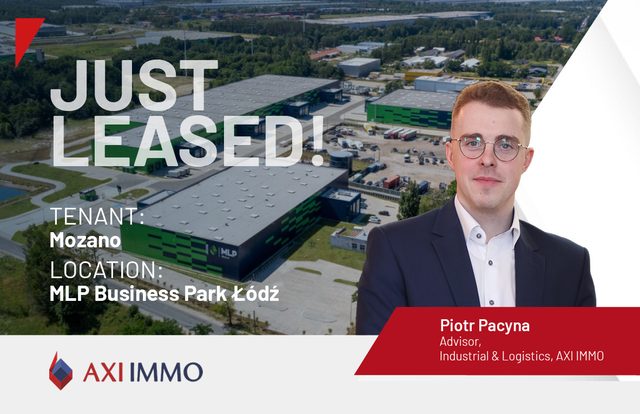
AXI IMMO supports Mozano in its logistics centre relocation to MLP Business Park Łódź
Mozano leases 4,600 sqm of space in Łódź
31 August 2026
Kraków Office Market Increasingly Polarised Between City Centre and Non-Central Zones
AXI IMMO PRESENT REPORT "OFFICE MARKET IN KRAKÓW H1 2026"