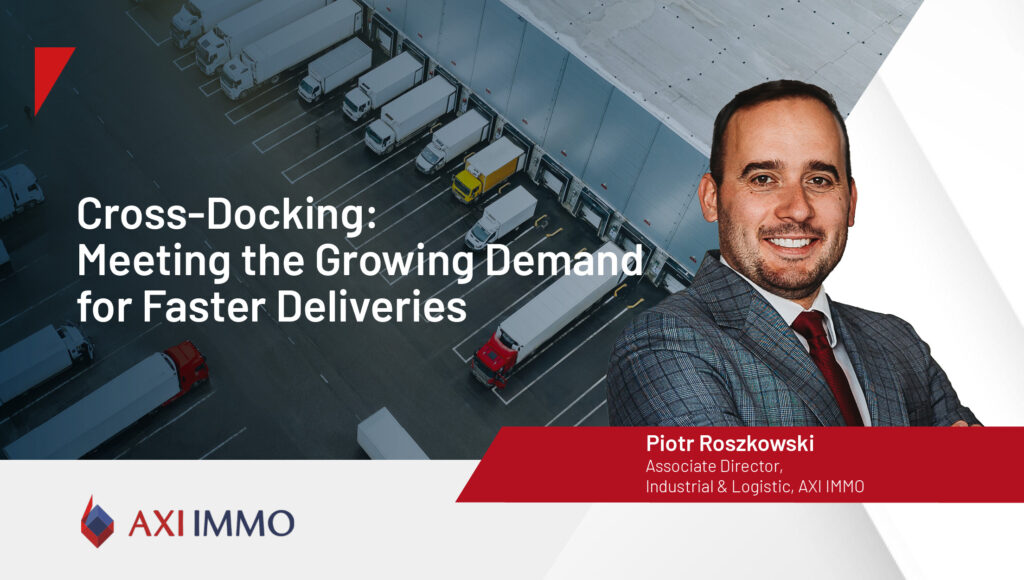
Cross-Docking: Meeting the Growing Demand for Faster Deliveries
The AXI IMMO expert explains how cross-dock facilities work, which occupiers benefit most from them and why their role is growing as demand for faster deliveries increases.
- How cross-dock facilities differ from traditional warehouses and how they operate in practice?
- How cross-docking can shorten delivery times, reduce logistics costs and improve supply chain efficiency?
- Which occupiers and logistics operations benefit most from cross-dock facilities and when conventional warehousing is a better option?
- Why e-commerce, same-day and next-day deliveries, and last-mile logistics are increasing demand for cross-dock facilities?
Estimated reading time: 5 minutes
Cross-dock facilities represent a specialised category of logistics facilities whose primary function is the rapid transfer of goods between inbound and outbound transportation with minimal storage time. Unlike traditional warehouses, their key parameter is not storage capacity but throughput, understood as the ability to handle a large number of vehicles and significant volumes of goods passing through the facility, says Piotr Roszkowski, Associate Director, Industrial & Logistics, AXI IMMO.
Cross-dock warehouse – how does it differ from a traditional warehouse?
A distinctive feature of cross-dock facilities is their exceptionally high ratio of loading docks to leased space. These are often located on both sides of the building, enabling the simultaneous handling of multiple vehicles and the smooth flow of goods through the facility. Extensive manoeuvring yards and an increased number of HGV parking spaces are also important elements of the infrastructure, ensuring uninterrupted operations around the clock.
Piotr Roszkowski, Associate Director, Industrial & Logistics Agency, AXI IMMO, comments:
“The allocation of space within cross-dock facilities differs from that of conventional distribution warehouses.
Piotr Roszkowski, Associate Director, Industrial & Logistics Agency, AXI IMMO
A smaller proportion is dedicated to storage, while greater emphasis is placed on transhipment, sorting and the short-term staging of goods.
As a result, cross-dock facilities help reduce delivery times, lower logistics costs and improve overall supply chain efficiency”.

Who are the main occupiers of cross-dock facilities?
The main groups of potential occupiers include logistics operators (3PL and 4PL providers), transport companies, courier firms and distributors operating in sectors characterised by high inventory turnover, such as FMCG, food and pharmaceuticals. For these businesses, the ability to quickly redirect shipments to the next stage of the distribution network without the need for long-term storage is of critical importance.
Cross-docking supports fast deliveries and last-mile logistics
Cross-dock facilities are also used as regional distribution centres and parcel sorting hubs, supporting the consolidation of deliveries from multiple locations and their subsequent redistribution to end customers. They play a particularly important role in the courier and e-commerce sectors, where parcels typically remain within the facility for only a few hours before onward transportation. In this model, cross-dock facilities support next-day and same-day deliveries, forming an important part of last-mile logistics infrastructure.
A cross-dock warehouse is not suitable for every logistics operation
It should be noted, however, that cross-dock units are not the optimal solution for occupiers conducting traditional fulfilment operations. E-commerce companies maintaining extensive product portfolios, high inventory levels, and carrying out order picking and packing activities primarily require substantial warehouse space. In such cases, conventional distribution centres and fulfilment warehouses offer greater functionality.
“From the perspective of the logistics real estate market, cross-dock units remain a product dedicated primarily to companies operating in the transport and logistics sector, as well as businesses managing intensive goods flows.
Piotr Roszkowski, Associate Director, Industrial & Logistics Agency, AXI IMMO
Due to their specialised nature, such facilities are often designed around specific operational requirements, and their functionality is more specialised than that of standard warehouse units.
In practice, these facilities are frequently occupied by a single operator or a limited number of tenants for whom a high number of loading docks and efficient transhipment processes are essential”.
Location is key to efficient cross-dock operations
Cross-dock units achieve their greatest market potential in locations providing access to key transport corridors, motorway interchanges, expressways, intermodal terminals and major urban agglomerations. As e-commerce continues to grow and the importance of fast deliveries increases, their role within modern logistics networks will continue to expand.
If you are looking for a cross-dock warehouse, contact us.
About AXI IMMO
AXI IMMO is the largest Polish commercial real estate advisory firm, providing services in leasing and investment transactions, industrial & logistics and office property management, property valuation, as well as the acquisition and disposal of development land. AXI IMMO’s key strength lies in combining international service standards with in-depth knowledge of local markets.
The company has received numerous international and domestic awards, including Advisor of the Year and Local Advisor of the Year titles from organisations such as CEEQA, CEE Investment Awards, CIJ Awards and Prime Property Prize. Most recently, in 2025, AXI IMMO was awarded the title of Warehouse Agency Team of the Year by the Eurobuild Awards jury.
Recent articles
13 October 2026
Cross-Docking: Meeting the Growing Demand for Faster Deliveries
The AXI IMMO expert explains how cross-dock facilities work, which occupiers benefit most from them and why their role is growing as demand for faster deliveries increases.
23 September 2026
The Warsaw Office Market Is Shifting.The Best Office Space Is Becoming Scarce
AXI IMMO analyses how falling vacancy rates and limited new office supply are reshaping the Warsaw office market and occupiers’ leasing strategies

17 September 2026
The best Real Estate Agencies in Poland
Commercial real estate agencies in Poland – how to choose the best one?
10 September 2026
AXI IMMO supports Mozano in its logistics centre relocation to MLP Business Park Łódź
Mozano leases 4,600 sqm of space in Łódź