Serviced Offices – When This Leasing Model Truly Makes Sense
Thinking about a new office? This guide breaks down the differences between a serviced office and a traditional one to help you find the most cost-effective option for your business.
Estimated reading time: 8 minutes
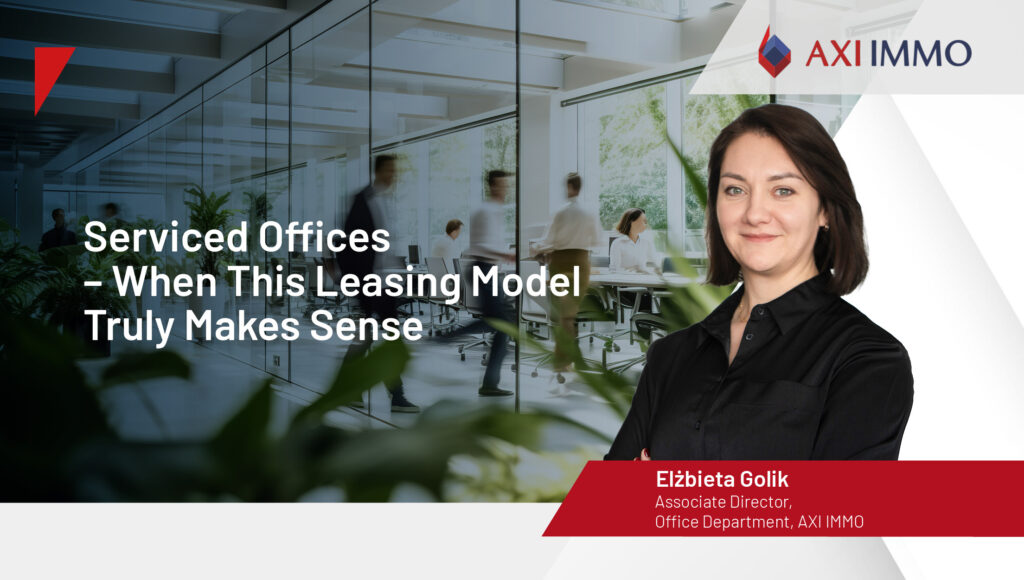
Recent years in the office market have brought a shift in how companies approach workplace strategy. Operational flexibility has become one of the key drivers of competitive advantage. This trend is closely linked to the growing popularity of serviced office solutions. But is this leasing model suitable for every business? Elżbieta Golik, Associate Director, Office Agency, AXI IMMO, Poland’s largest commercial real estate advisory firm, offers her perspective.
Shorter Planning Horizons and the End of “Reserving Space”
Companies are increasingly shortening their planning horizons. In an uncertain economic climate and amid growing competition for talent, businesses are reluctant to “freeze” capital in office space they may never use. This shift is influencing the entire office market and accelerating the development of serviced offices, according to analysis by Elżbieta Golik.
Elżbieta Golik, Associate Director, Office Agency, AXI IMMO explains: “The growing popularity of serviced offices stems from a fundamental change in how companies organise work and plan resources. In many sectors, particularly technology, engineering and consulting, project-based models dominate, with team sizes changing every few months. In such conditions, traditional leasing based on long-term contracts and fixed space allocation is no longer adequate. Serviced offices can address this challenge in certain cases, although they are not always the optimal solution.”
Traditional Leasing – No Longer a Default Choice
It is increasingly rare for companies to reserve space “just in case”, for future projects whose implementation is uncertain. Flexible lease agreements allow for precise adjustment of space to current needs, resulting in greater cost efficiency and reduced investment risk. This is especially important in an environment where competitive pressure and macroeconomic uncertainty demand caution in making long-term commitments.
Serviced offices offer a solution. They allow companies to adjust the number of workstations on an ongoing basis, avoiding the cost of surplus space that adds no operational value. They are also a natural choice for businesses without a local administrative structure or those testing their presence in a new city. For organisations entering the Polish market, the ability to launch operations immediately – without fit out works, hiring administrative staff or negotiating complex contracts – is a major advantage. Ready to use infrastructure and full operational support enable companies to start functioning virtually overnight.
Regional Expansion and Leasing Strategy
From an investor’s perspective, S&L provides an opportunity to acquire fully leased, income-producing assets managed by experienced users. This reduces risk and enhances predictability of returns. When transactions involve financially stable and well-established tenants under long-term leases (10–20 years), the investment becomes even more attractive—particularly in industrial and logistics sectors.
S&L as a safer investment model than purchasing a speculative asset
The same applies to companies considering expansion into new locations. Kraków is one example of a city that organisations prefer to test before committing to a long-term lease. Serviced offices allow them to assess market potential, talent availability and operational costs with minimal risk.
Flexible Leasing for Project-Based Work
Flexible spaces also serve an important role as temporary solutions, according to Elżbieta Golik. They are used by implementation centres, IT teams working in project sprints, companies undergoing internal transformations or organisations relocating employees for a defined period. In such cases, the ability to quickly activate ready-made infrastructure for the duration of a project – without investing in fit out or equipment – is key.
Serviced Offices – Not for Everyone
However, serviced offices are not a universal solution. For stable teams above a certain scale, the model becomes less cost-effective. The cost per workstation is higher than in traditional leasing, so when a company knows its target headcount and does not anticipate dynamic changes, conventional leasing becomes the more rational choice. Another limitation is personalisation. Serviced offices typically do not allow full branding, reconfiguring the layout or placing signage in the lobby or on the building façade. For companies focused on brand visibility and creating a unique working environment, traditional leasing offers far greater flexibility.
When Traditional Lease Pays Off
It is also worth noting that although moving into a traditional office involves higher initial costs – fit out, equipment, relocation – in the long term this model is more economical. Lower rental rates, greater predictability of operating costs and the ability to tailor space to internal processes make it a more cost-effective option for large, stable organisations.
Elżbieta Golik, concludes: “Serviced offices should be treated as a tool that enables companies to operate faster, more flexibly and with lower risk. They are ideal during periods of change, growth, market testing or projects requiring immediate operational readiness. However, once an organisation reaches stability and a clearly defined scale, transitioning to traditional leasing becomes the natural next step. The key is to align the office model with the company’s stage of development and its operational and cost strategy”.
If you are looking to lease an office, contact us.
Expert
Elżbieta Golik
Associate Director
Office Agency, AXI IMMO

About AXI IMMO
AXI IMMO is the largest Polish commercial real estate advisory firm, providing services in leasing and investment transactions, industrial & logistics and office property management, property valuation, as well as the acquisition and disposal of development land. AXI IMMO’s key strength lies in combining international service standards with in-depth knowledge of local markets. The company has received numerous international and domestic awards, including Advisor of the Year and Local Advisor of the Year titles from organisations such as CEEQA, CEE Investment Awards, CIJ Awards and Prime Property Prize. Most recently, in 2025, AXI IMMO was awarded the title of Warehouse Agency Team of the Year by the Eurobuild Awards jury.
Recent articles
31 March 2026
Serviced Offices – When This Leasing Model Truly Makes Sense
Thinking about a new office? This guide breaks down the differences between a serviced office and a traditional one to help you find the most cost-effective option for your business.
30 March 2026
AXI IMMO advises Bel-Pol on a 5,600 sq m warehouse lease at Panattoni Park Warsaw North III, Poland, March 2026
Bel-Pol secures modern logistics and warehouse space in the north-eastern Warsaw agglomeration.
25 March 2026
AXI IMMO Report: Analysis of the Warehouse & Industrial Sector in the Łódź Voivodeship, Central Poland
Łódź's Logistics Sector Booms, Reaching 1.17 Million Sqm in Tenant Demand!
24 March 2026
10000 sq warehouse space for TVM Group in Poland, AXI IMMO Advices
TVM Group was supported throughout the property selection process and lease negotiations by AXI IMMO.