Report: Investment land – how much per square meter in Poland?
Analysis of prices on the market of investment land for warehouse and production development - Report AXI IMMO - "Investment land for warehouse and production projects in Poland".
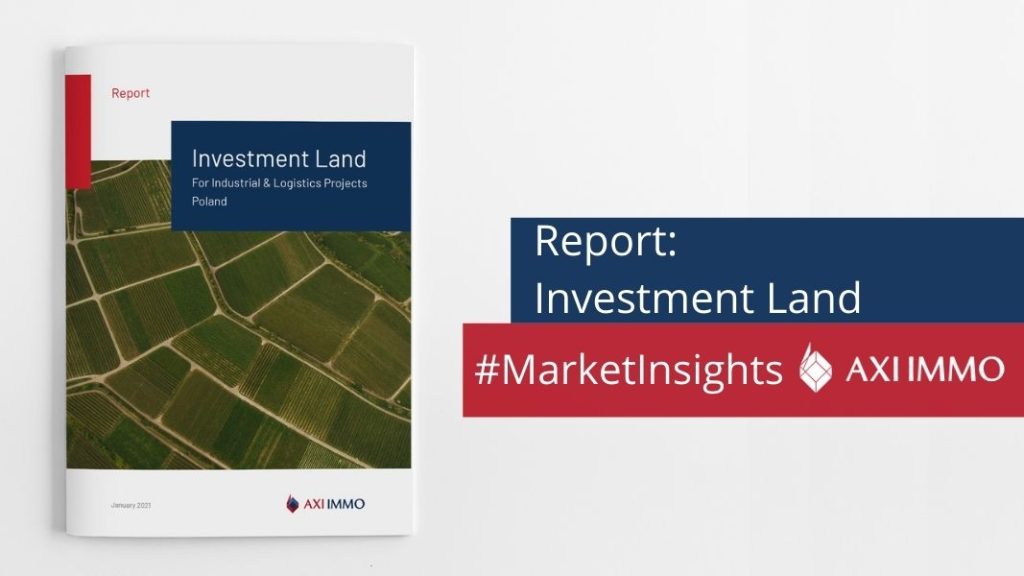
Healthy occupier demand combined with high development activity has, in recent years, resulted in increased appetite for investment land for industrial and logistics properties in Poland. Plot prices have risen in the most attractive locations. Suitable, well-located greenfield land has become scarce, prompting developers to turn to brownfield plots. The Covid-19 pandemic has not had a material impact on the demand-supply balance in the land market.
The AXI IMMO advisory firm has prepared an in-depth analysis of investment land prices, which is included in the ‘Investment Land for Industrial and Logistics Projects in Poland‘ firm’s latest report.
High demand for investment plots
Over the last two years, demand for investment plots has been the highest around the largest urban centres in the country. Warsaw, Wrocław, Upper Silesia, Łódź and Poznań are still the most sought-after locations. This group has been joined in recent years by Tricity and Kraków. Moreover, Western Poland has seen increased demand due to its proximity to the German border. There has also been significant interest in production and logistics facilities in Eastern Poland, where access to workers is relatively good, and labour costs are attractive. Other new locations continue to emerge as they are being unlocked by rapidly improving road infrastructure.
-“Supply of investment plots in key distribution hubs such as Warsaw, Kraków, Bielany near Wrocław, Stryków near Łódź or Komorniki near Poznań is highly limited. Developers and owner-occupiers are therefore often forced to seek plots nearby, close to adjacent interchanges, where availability tends to be higher. This is helped by infrastructure improvements, with new sections of expressways and motorways opening up new locations. For example, extending the A2 motorway east of Warsaw promoted the Stary Konik and Mińsk Mazowiecki markets, while extending the A1 motorway put Częstochowa on Poland’s logistics map”. – explains Tomasz Oborski, Head of Land Advisory, AXI IMMO.
Ongoing e-commerce growth is fuelling demand for land suitable for last-mile logistics facilities. Such urban plots are, however, increasingly scarce, and their prices are high. As a result, developers are forced to either place competitive bids on the last remaining greenfield sites or pursue brownfield investments on post-industrial sites. Urban plots are particularly sought after in Warsaw, Upper Silesia and Wrocław.
Investment land prices in Poland – how much per square meter?
Land prices in Warsaw far exceed those recorded in other parts of the country. The average price of investment land prepared for warehouse development ranges from PLN 450 to 650 per sqm. Plots further out of the city are more affordable, at PLN 250-350 per sqm in the second zone, which includes e.g. Pruszków and Nadarzyn, and just PLN 100 per sqm in the third zone, in locations such as Sochaczew or Teresin. The Kraków land market takes second place, with transaction prices at PLN 400-450 per sqm, and Wrocław comes third, with rates between PLN 180 and 300 per sqm. Average prices on other Polish markets are in the range of PLN 100-200 per sqm and depend on demand and the level of land supply. The presence of local plans and the quality of local infrastructure also affect land prices in a given location.
– “The role of local authorities cannot be underestimated. The process of obtaining a building permit is often much easier and quicker in smaller towns compared to large urban centres, where investors from various segments of commercial and residential real estate compete for plots”. – adds Tomasz Oborski.
Investment land in Europe
In a European context, Poland offers highly attractive land prices and much shorter administrative procedures for commercial real estate development. In terms of investment land prices in industrial and logistics locations, only the South Moravian region in Czechia and the eastern part of Slovakia offer rates comparable to the most affordable Polish market, Poznań. Smaller markets, such as Stargard Szczeciński, Mszczonów near Warsaw, Piotrków and Stryków (outside Łódź), Tarnów in Lesser Poland, or Częstochowa, are even more attractively priced. The most expensive Polish market – Warsaw – is still 5.5 times cheaper than Greater London and 2.7 times cheaper than Munich. In terms of administrative procedures, obtaining environmental approvals, a building permit and utility connection decisions takes an average of 12-18 months in Poland, whereas in some parts of Western Europe, a building permit alone can take 24 months.
– “In most European industrial and logistics hubs, land prices reflect the level of rent, which is in turn determined by the strength of demand and the structural supply of land. We should not forget about barriers to entry that may exist in parts of the continent for real estate development, such as rigorous and bureaucratic planning systems, the reluctance of local authorities towards warehouse and industrial developments or natural barriers such as mountains. A market’s political and macroeconomic stability also plays a role. All these factors affect the availability of land and its price”. – explains Renata Osiecka, Managing Partner, AXI IMMO.
Land – changes during the pandemic
The COVID-19 pandemic has had a significant impact on the activity of warehouse developers. It has primarily resulted in a reduction in space built on a speculative basis. At the end of 2019, only 50% of warehouse space under construction was pre-let. This share declined to 26% at the end of Q3 2020 and continues to fall as developers are affected by banks’ more conservative attitudes. Access to financing has worsened considerably, with the pre-let ratio banks require for new developments edging up to 50%. Nevertheless, fundamental demand for land in the most attractive locations remains stable at previous high levels.
– “Important changes have occurred as a result of the pandemic. Firstly, decision-making processes have become longer as developers apply even more scrutiny during due diligence prior to a land acquisition. Secondly, administrative procedures, including environmental approvals and building permits, take more time due to the so-called Covid-19 law, which allows local authorities to exceed time limits set for considering applications”. – explains Tomasz Oborski.
Read also the report for the warehouse market in Poland: Report – Polish Warehouse Market in Q1 2021
Report — Investment Land For Industrial & Logistics Projects, Poland
Please complete the form below to receive a full report on your Mailbox
Recent articles
10 September 2026
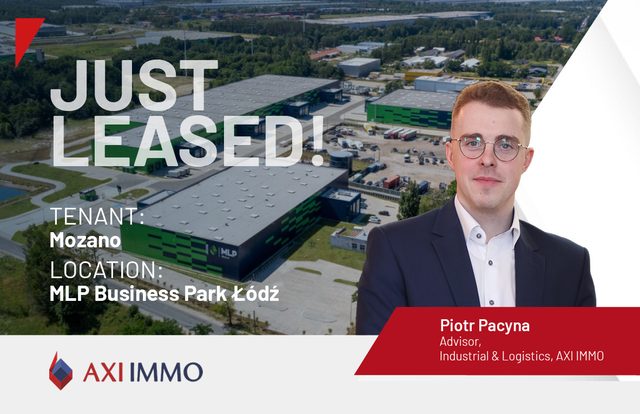
AXI IMMO supports Mozano in its logistics centre relocation to MLP Business Park Łódź
Mozano leases 4,600 sqm of space in Łódź
31 August 2026
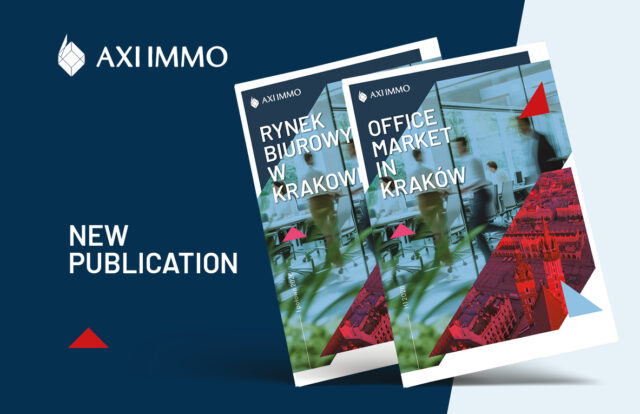
Kraków Office Market Increasingly Polarised Between City Centre and Non-Central Zones
AXI IMMO PRESENT REPORT "OFFICE MARKET IN KRAKÓW H1 2026"
24 August 2026
AXI IMMO: Net Take-Up Up 58% as Availability of Large Warehouse Units Reshapes Market Dynamics
AXI IMMO present report "Industrial and Logistics Market in Poland – H1 2026"
18 August 2026
Regional Office Markets: Fewer Transactions, More New Leases as Occupiers Prioritise Quality
AXI IMMO PRESENT REPORT "OFFICE MARKET IN REGIONS H1 2026"